Key Takeaways
- Choose brightness for trail speed, surface detail, weather, and navigation difficulty rather than chasing the highest lumen claim.
- Compare runtime at the mode you expect to use; maximum output may step down quickly as the lamp heats or the battery drains.
- A broad, even beam helps with footing, while a controlled spot beam helps with junctions and distant markers.
- Carry a small backup light and enough power for the planned route plus a delayed return.
How this guide was built
Fopoto reviews how many lumens do you need for night hiking? through a compact-kit lens: brightness, runtime, beam pattern, backup power, and visibility after dusk. We start with the safety baseline, then cut anything that adds bulk without covering a realistic field problem. This guide is written for the practical search intent behind how many lumens for night hiking and related questions like night hiking headlamp lumens, headlamp brightness for hiking, headlamp runtime vs lumens.
How Many Lumens Do You Need for Night Hiking? is not about buying more gear. It is about building a small, repeatable system for night hiking that still works when the day gets longer, colder, wetter, or more confusing than planned.
| Layer | What it covers | When to pack it |
|---|---|---|
| 100-200 lumens | Camp tasks, map checks, slow walking on familiar ground | Prioritize long runtime and low glare |
| 200-350 lumens | Typical night hiking on maintained trails | Useful starting range for many hikers |
| 350-500 lumens | Faster movement, rough terrain, route finding | Check heat step-down and battery drain |
| Backup light | Slow exit, map reading, signaling after failure | Pack separately from the main headlamp |
How many lumens do you actually need for night hiking?
Start with the lowest stable mode that shows the next few steps, trail edges, and nearby markers without flattening every shadow. Around 200-350 lumens often covers maintained trails at a normal walking pace. Use more light when the ground is technical, the route is hard to read, or weather reduces contrast.
Brightness needs change with speed, terrain, eyesight, fog, rain, and reflected glare. Test the exact lamp outdoors before relying on it.
Why runtime matters more than maximum lumens
The maximum-lumen figure usually describes the brightest available mode, not the output a headlamp can sustain for an entire walk. Compare the published runtime at medium output, note whether brightness is regulated or gradually fades, and plan enough power for the route plus a conservative delay margin.
A steady medium mode for several hours is usually more useful than a brief high-output burst followed by rapid step-down.
How beam shape changes what you can see
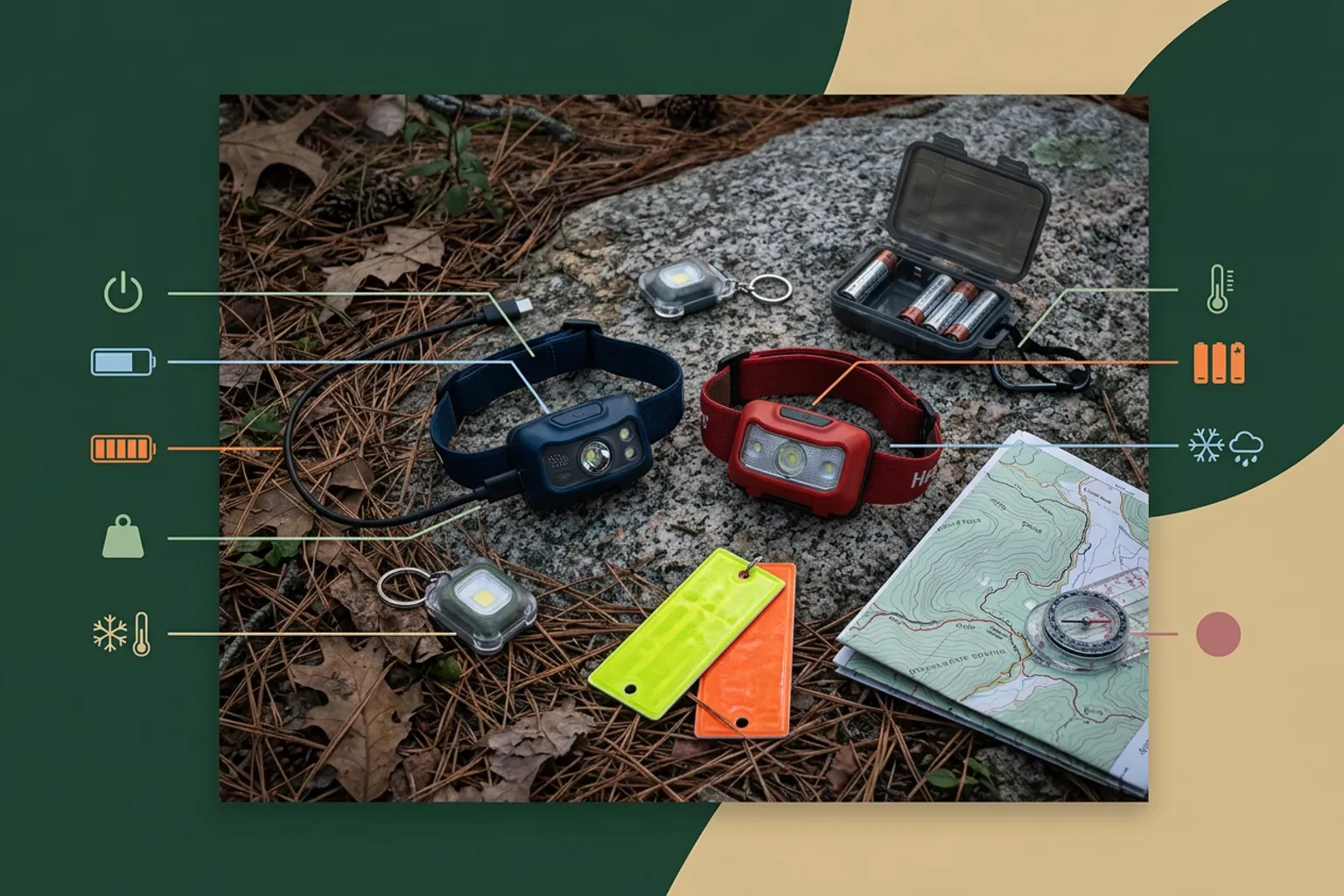
A broad flood beam reveals roots, rocks, and trail edges close to your feet. A tighter spot beam helps identify distant signs and junctions. Many hikers benefit from a balanced beam rather than a narrow, high-intensity hotspot that creates glare and weak peripheral detail.
Use lower modes around other walkers and reflective signs so glare does not erase nearby detail.
What should be in your lighting backup plan?
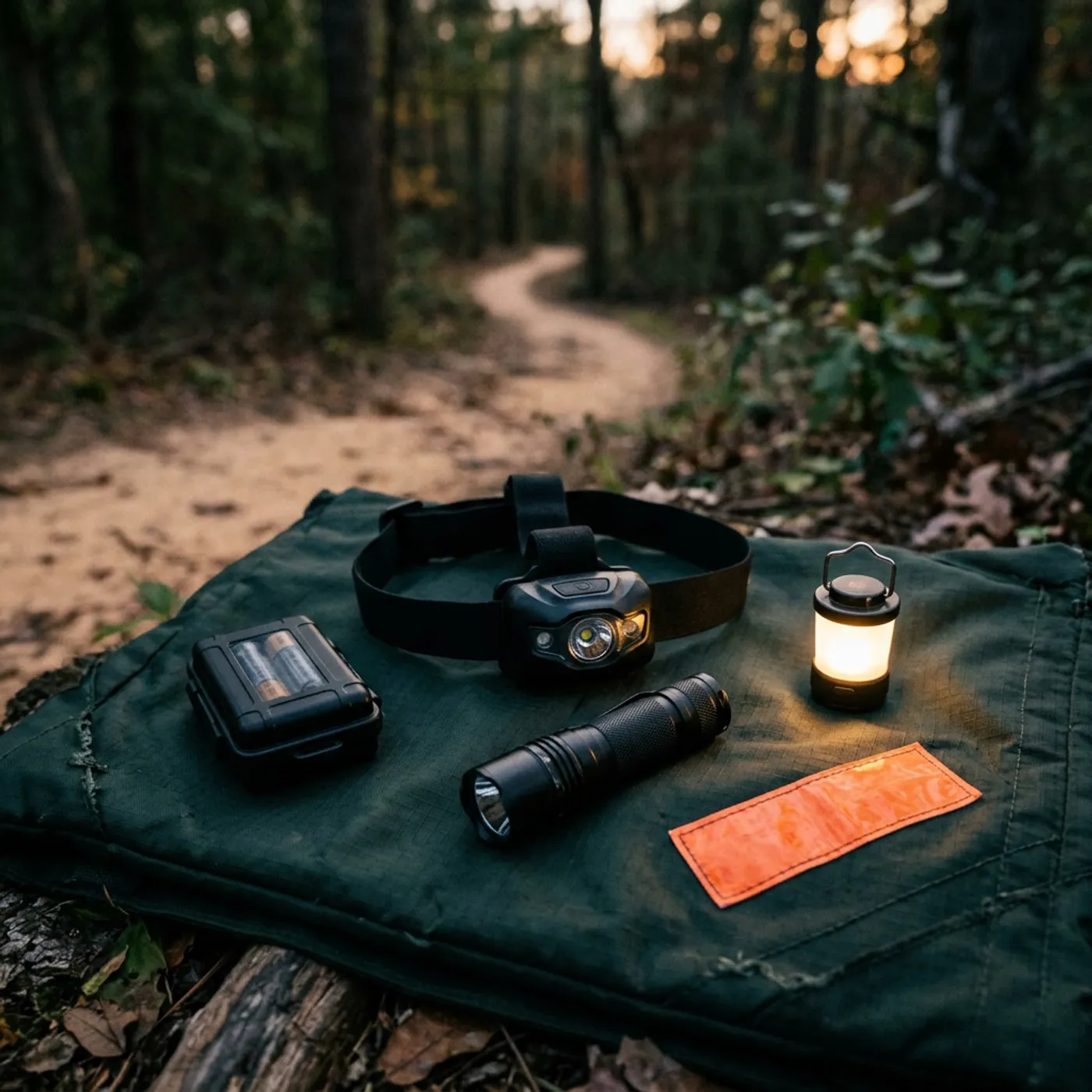
Carry a separate mini headlamp or small flashlight where you can reach it in the dark. Check charge or batteries before leaving, prevent accidental activation in the pack, and avoid using the phone torch as the only backup because the phone may be needed for navigation or emergency contact.
The backup does not need extreme brightness. It needs to be dependable enough for a slow exit, map reading, and signaling.
Compact checklist
- Main safety item for the route, season, and time of day.
- Specific plan for a late return, a light that steps down too quickly, glare that ruins footing, or a battery that is not charged when the trail gets dark.
- Backup light or backup power if the trip can run late.
- Weather layer that works for both wind and rain.
- Small first aid and blister kit sized for the group.
- Navigation backup that does not depend only on cell service.
- Carry rule: choose one primary light you enjoy using and one tiny backup that lives in the same pouch.
Frequently asked questions
Is 300 lumens enough for night hiking?
For many maintained trails at a normal walking pace, 300 useful lumens can be enough. Rough ground, faster movement, poor weather, or difficult route finding may require more light, while runtime and beam quality remain equally important.
Is 1,000 lumens too bright for hiking?
A 1,000-lumen burst can help with brief route checks, but it is rarely necessary as a continuous hiking mode. High output can drain the battery quickly, create reflected glare, and step down as the lamp heats.
How much headlamp runtime should I plan?
Plan for the expected low-light portion of the route plus a conservative delay margin. Use the runtime for the medium mode you will actually hike with, not only the lowest-mode or maximum-output claim.
Sources
- National Park Service: Hike Smart, retrieved August 25, 2026. Official guidance on route planning, essential equipment, weather, hydration, and emergency preparation.
- National Park Service: Ten Essentials, retrieved August 25, 2026. Official checklist that recommends illumination, preferably a headlamp, with spare batteries.
- National Park Service, Ten Essentials , retrieved August 25, 2026. Used as the safety baseline for compact outdoor packing systems.
- American Red Cross, First Aid Kit guidance , retrieved August 25, 2026. Used for first-aid kit scope and emergency-preparedness checks.
- Fopoto Editorial Policy, updated August 25, 2026. Explains the scenario-first review method, AI-assisted image disclosure, and source standards.
- Fopoto Field Desk, updated August 25, 2026. Describes the editorial team, review boundaries, correction path, and compact-kit evaluation method behind this guide.
Updated August 25, 2026 / 7 min read