Key Takeaways
- A packed item only helps if it works and you know how to use it.
- Choose the route for the whole group and its current abilities.
- Record your turnaround and emergency plan before fatigue affects decisions.
How this guide was built
Desk-researched preparation checklist, reviewed October 15, 2026. The ten entries are editorial checks, not survey results about the most common mistakes.
Forgotten equipment is only half the problem. You can pack a map and still choose a route beyond your navigation skill; carry a light and still ignore the turnaround time. This guide pairs small packing checks with the decisions that make those items useful.
| Failure type | Example | Better check |
|---|---|---|
| Missing item | No light in a daypack | Switch it on before departure |
| Unusable item | Offline map not downloaded | Open the route without a connection |
| Decision error | Continuing after the agreed cutoff | Turn around while you still have a return margin |
Which mistakes are solved by packing?
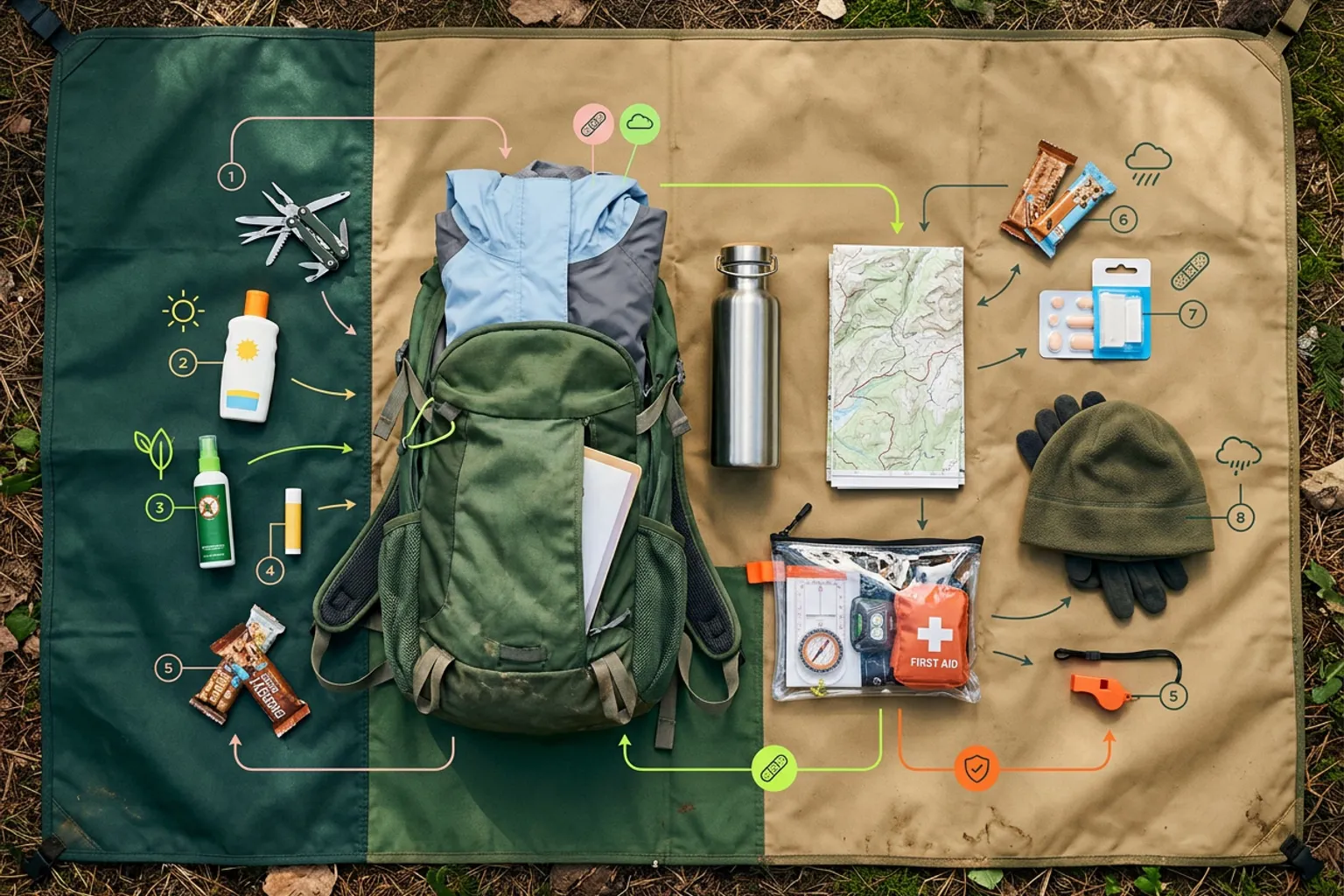
A functioning light, suitable weather layer and accessible food solve different problems. Review the Ten Essentials by function rather than adding ten arbitrary objects. Our compact packing check is to find each item without unpacking the whole bag and confirm it can perform its job.
This checklist is not a universal equipment list; route, weather and park requirements decide the final kit.
Which mistakes need a different decision?
NPS advises choosing a trail that fits the group and leaving a trip plan. Our decision check adds an explicit turnaround commitment: decide what will end the outing before you reach a tempting summit or the group becomes tired. More battery capacity does not compensate for an itinerary beyond your ability.
An easier route or an earlier return can be a better improvement than another purchase.
Practice the failure before the hike
Try opening your navigation without a connection, operating your light and finding your weather layer. These are suggested preparation exercises, not Fopoto field-test results. If a task is confusing at home, simplify it before relying on it outdoors.
Do not discover an incompatible cable or an unfamiliar map interface after you need it.
Make one change after each outing
Write down one item you could not find and one decision you would change. Fix those before adding another accessory. For a packing baseline, use the day-hiking guide ; for a navigation failure, read what to do if lost .
A short personal review is a way to improve your own preparation, not evidence of a tested product ranking.
Before you choose
- 1. Navigation: open your route and know your backup.
- 2. Trip plan: leave route and return details with a trusted contact.
- 3. Turnaround: agree the time and conditions for returning.
- 4. Forecast: check local conditions and route notices.
- 5. Water: confirm supply and a suitable margin.
- 6. Food: pack accessible food for delay.
- 7. Layer: keep appropriate weather protection dry and reachable.
- 8. Light: check operation and approved spare power.
- 9. Feet: use familiar footwear and carry personal foot care.
- 10. Emergency: save local procedures and check communication options.
Frequently asked questions
What is the difference between missing gear and a hiking mistake?
Missing gear means a needed function is absent or unusable. A decision mistake can happen with a full pack, such as choosing an unsuitable route or continuing beyond a planned turnaround.
Do beginners need to buy all new hiking equipment?
Start by checking the route requirements and whether your existing equipment performs each necessary function. Replace a real gap; avoid treating a shopping list as a complete safety plan.
Sources
- National Park Service: Hike Smart , retrieved October 15, 2026. Route choice, trip plans, emergency preparation and limits. Local park instructions take priority.
- National Park Service: Ten Essentials , retrieved October 15, 2026. Preparation systems; not a measured ranking of the most frequently forgotten items.
Updated October 15, 2026 / 5 min read